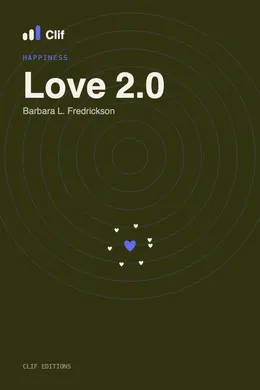
Love 2.0
Barbara L. Fredrickson · 2013
Love 2.0 (2013) is a book by Barbara L. Fredrickson on The Science of Connection. A psychologist redefines love not as a permanent bond with one person but as "positivity resonance," a recurring micro-moment of shared positive emotion, synced biology, and mutual care available with strangers, friends, and family alike.
Fredrickson replaces the soulmate myth with a testable biology: love as a renewable micro-moment anyone can have with almost anyone, over and over, all day.
Three of the ideas you’ll keep
The Clif summary of Love 2.0 pulls out 7 insights. Here are the first three.
- Fredrickson defines love as "positivity resonance": a momentary, shared positive emotion between two people, not a continuous feeling or a permanent possession.
- Every micro-moment of love requires three co-occurring ingredients: a shared positive emotion, biobehavioral synchrony (mirrored expressions, gestures, even physiology), and mutual care for each other's wellbeing in that instant.
- Her broaden-and-build theory explains what these moments do: positive emotion widens attention and thought-action options in the moment, and repeated widening builds lasting resources like resilience and social bonds.
The other 4 — and the full 11-minute summary — are in the app.
What’s inside: 9 chapters
The whole summary runs about 11 minutes, read or listened to.
- Redefining Love: From Romance to Micro-Moments
- The Three Ingredients of Positivity Resonance
- Broaden and Build: What Love Does to the Mind
- The Vagus Nerve and the Biology of Connection
- Oxytocin, Mirror Neurons, and Getting in Sync
- Love Beyond the Couple: Strangers, Pets, and Community
- The Cost of Loneliness and Emotional Malnutrition
- Cultivating Love: Loving-Kindness Meditation and the Upward Spiral
- Letting Go of Love 1.0: Living the New Theory
Finish Love 2.0 tonight.
Read or listen to the full summary in about 11 minutes, then keep the ideas with a minute of review a day. Start with the 2-minute quiz — no card required.
More on Finding Happiness
-
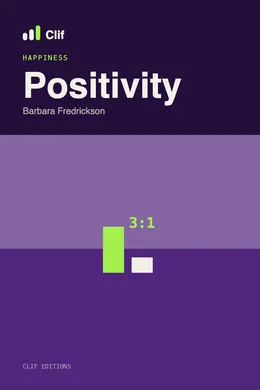 Positivity Barbara L. Fredrickson A research psychologist replaces feel-good clichés with a measurable claim: cross a roughly 3-to-1 ratio of good feelings to bad…
-
 Solve for Happy Mo Gawdat A Google[X] engineer reverse-engineered happiness into a formula, then watched it hold up against the worst day of his life.
-
 Stumbling on Happiness Daniel Gilbert Explains why our predictions about what will make us happy are systematically wrong, a key cognitive insight.
-
 The Art of Happiness Dalai Lama XIV & Howard C. Cutler The book that made "happiness is a skill you can train" mainstream, part Buddhist wisdom, part clinical psychology, entirely…
-
 The Book of Joy Dalai Lama and Desmond Tutu (with Douglas Abrams) Two Nobel laureates who each survived exile and oppression prove that lasting joy is not the absence of suffering but a skill you…
-
 The Conquest of Happiness Bertrand Russell Russell's answer to the Romantic pose of despair: happiness is not a metaphysical verdict on the universe but a habit of attention…