Diffusion of Innovations
Everett Rogers · 1962
Diffusion of Innovations (1962) is a book by Everett Rogers on Innovation & Adoption Theory. Rogers's foundational synthesis of hundreds of studies on how new ideas and products spread through a population over time: the adoption S-curve, five adopter types, and why "better" rarely means "faster adopted."
Explains, with real farm and hospital data, why a better product usually loses to a better-communicated one.
Two of the ideas you’ll keep
The Clif summary of Diffusion of Innovations pulls out 8 insights. Here are the first two.
- Adoption follows the **innovation-decision process**: knowledge, persuasion, decision, implementation, confirmation, five stages that can stall or reverse into discontinuance at any point, not a single yes/no moment.
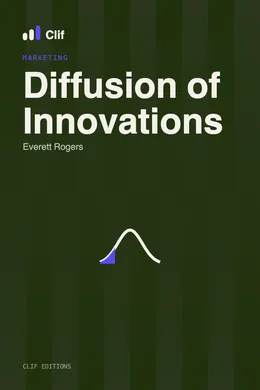
- Adopters sort into five ideal types along a **bell-shaped normal curve**: innovators (about 2.5%), early adopters (13.5%), early majority (34%), late majority (34%), and laggards (16%), each with a distinct social psychology, not just a different adoption speed.
The other 6 — and the full 11-minute summary — are in the app.
What’s inside: 9 chapters
The whole summary runs about 11 minutes, read or listened to.
- What Diffusion Actually Means
- The S-Curve and the Iowa Corn Farmers
- Five Attributes That Decide Adoption Speed
- The Innovation-Decision Process
- The Five Adopter Categories
- Opinion Leaders and the Two-Step Flow
- Critical Mass and Interactive Innovations
- Reinvention and the Consequences of Adoption
- Change Agents and the Heterophily Problem
Finish Diffusion of Innovations tonight.
Read or listen to the full summary in about 11 minutes, then keep the ideas with a minute of review a day. Start with the 2-minute quiz — no card required.
More on Growth
-
 Duct Tape Marketing John Jantsch It swaps "try another tactic" for a repeatable system, so a small business stops chasing marketing fads and starts turning…
-
 Growth Hacker Marketing Ryan Holiday The book that gave a name and a method to the Silicon Valley trick of making the product market itself.
-
 Hacking Growth Sean Ellis & Morgan Brown The playbook that turned "growth hacking" from a buzzword into a repeatable, testable system for scaling Dropbox, Airbnb, and…
-
 Lean Marketing Allan Dib It takes the discipline that turned Toyota's factories into the world's most efficient production lines and hands it to any…
-
 Product-Led Growth Wes Bush The book that gave B2B SaaS a name, and a repeatable method, for growth that runs through the product instead of through the sales…
-
 Stand Out Dorie Clark In a world drowning in noise, being competent isn't enough. Clark shows how to develop a breakthrough idea and build the audience…